



Selecting the Right Crane Systems To Boost Productivity
May 7, 2015
Thirty years ago a typical small engineering workshop would probably have had one all-purpose crane. This would have served all needs from unloading raw materials through machine shop processing, to product build-up, final assembly and shipping. If personnel had to wait for crane availability, then this was accepted.
Move forward to today and the situation is more pressing. The world is one big workshop and though the tide of offshoring seems to be on the turn, competition is now global and intense. Lean manufacturing, making capital assets like plant and buildings work harder and ensuring people can get on with the job are now core principles. Cranes have a key role in keeping workshops buzzing.
Using Cranes Effectively – Two Examples
The Mechanical Drives division of Siemens Industry Automation and Drive Technologies in Leeds is typical of many light engineering applications. The factory produces mechanical drives and power transmission components for industry including geared motors, couplings, gear units and drive train assemblies. Manufacturing and assembly operations are diverse, requiring component part handling, assembly and the movement of product through key stages until completion and test before shipping.
Manufacturing cells are serviced by six light crane systems, with up to six metres span, capable of lifts of up to 1 tonne each. These light and adaptable crane systems were supplied complete with chain hoists and independent gantry support. They provide flexible and adaptable lifting for lighter loads and ensure safe handling.
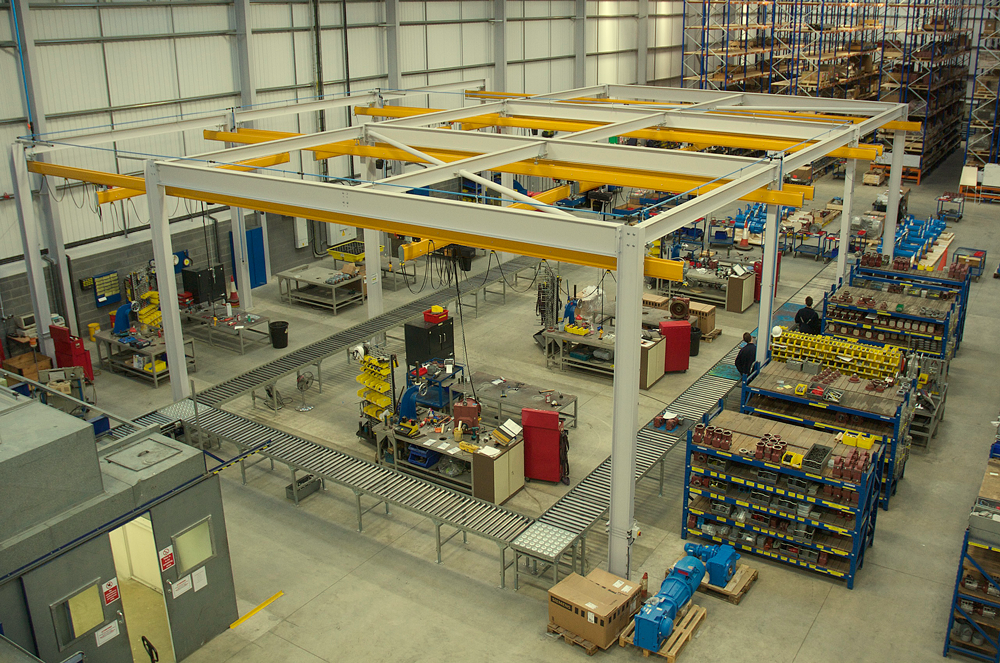
The light crane systems give complete access to the work area with full vertical movement and both x and y movement in the horizontal plane. Elsewhere on the Siemens site, Goliath and overhead travelling cranes (OTC’s) handle heavier lifts.

Operating at the heavy end of the engineering business, Mining Machinery Developments (MMD) in Derbyshire make sizing plant used by mines and quarries. To optimise production, a mix of OTC’s and jib cranes provide a flexible system for production flow that is easily adapted to meet future expansion.
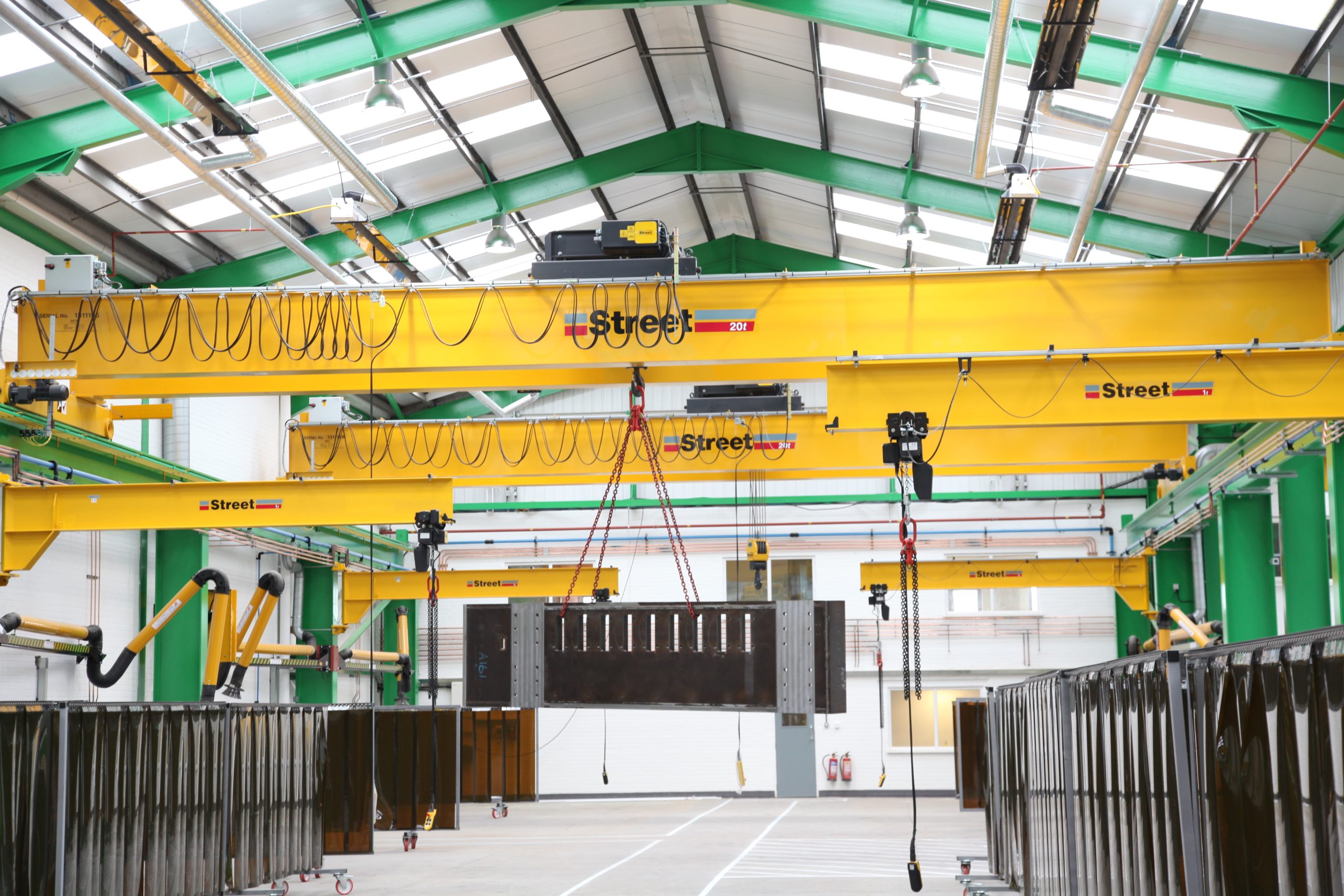
Three 20 tonne overhead cranes in each of two new bays run on full-length freestanding 60 metre gantries. The cranes are used for offloading vehicles and advancing product through the various stages of production. Having adequate cranage in the production area underpins productivity as the highly skilled workforce can avoid down time waiting for cranes to become available.
Cranes are double girder box beam design and feature infra-red anti-collision systems so they can safely work on the same track. For heavier lifts of up to 40 tonnes, they may be used in tandem and weight distributed by a spreader beam.
The new bays are also equipped with 10 one-tonne jib cranes, with seven units in one bay and three in the adjoining bay. Each jib crane services a workstation manned by two welders or platers. The slewing jib cranes are attached to the gantry legs with fittings that can be dismantled, enabling the jibs to be readily re-located as production needs change.

Within the assembly bays, are two double girder cranes of 50 tonnes and one of 25 tonnes. One of the larger units has an auxiliary 15 tonne hoist to give greater materials handling flexibility.

Special Considerations
It’s worth taking time to brief your crane supplier thoroughly about the production process. Crane manufacturers are critically aware of the need for safety and will optimise crane speed with stability to ensure the safe transportation of loads.
Manufacturers also need to know about the intensity of crane use, both the number of lifts and movements per day and the proportion of loads at the upper end of the rated load. This information enables cranes and components to be selected with correct mechanism rating – essential for sustained and reliable operation. It is also worth considering how to customise and accessorise the crane to improve operations, from simple load spreading beams to the use of bespoke handling equipment to improve safety and productivity.
International competition won’t go away, but innovation, flexibility and productivity, assisted by the right mechanical handling can ensure UK manufacturing remains viable and competitive.

Four Street Cranes for A V Dawson’s Super-Sized Automotive Steel Coil Store
May 1, 2015
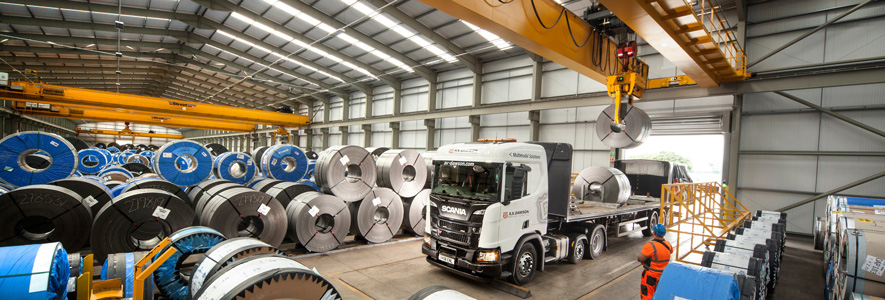
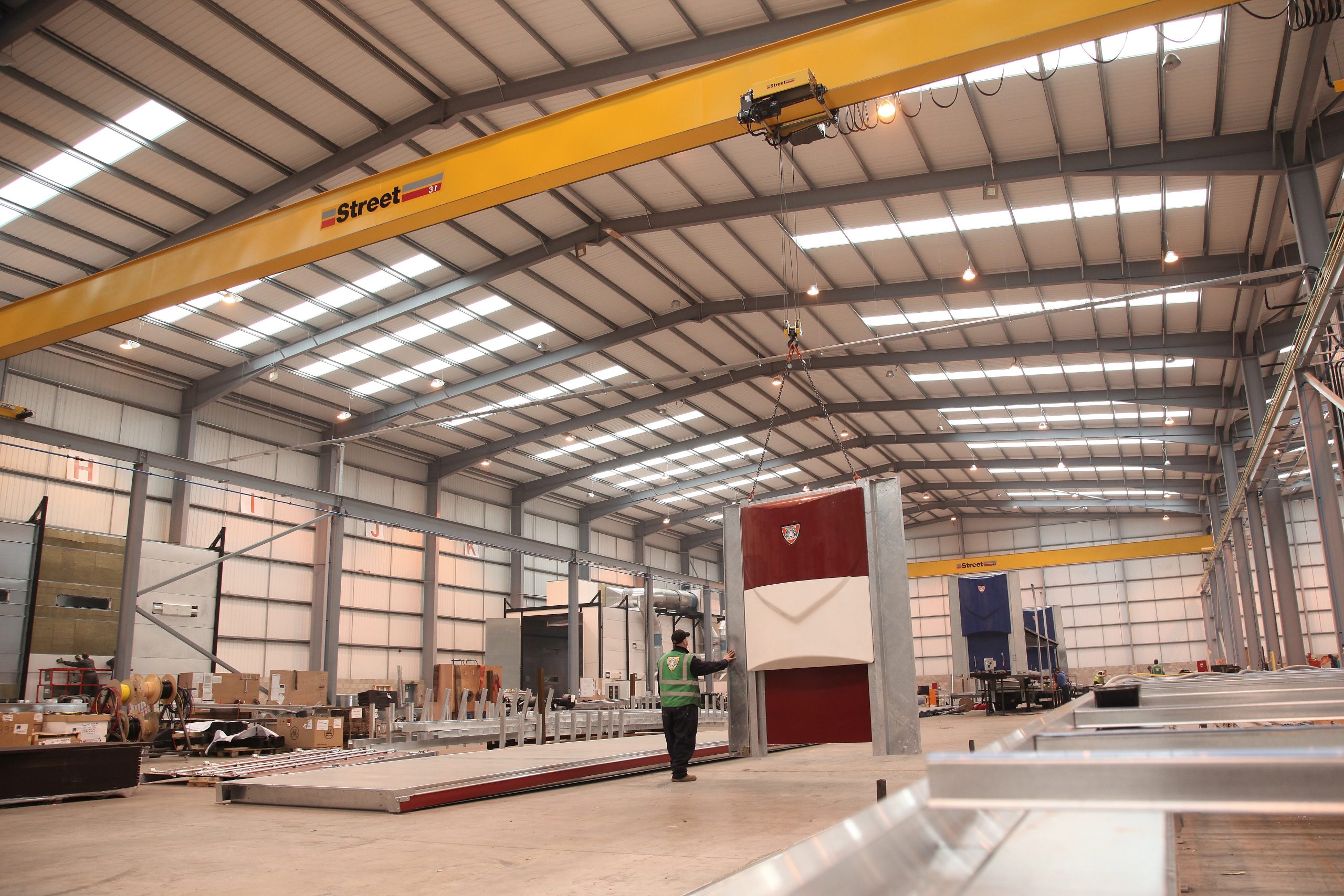
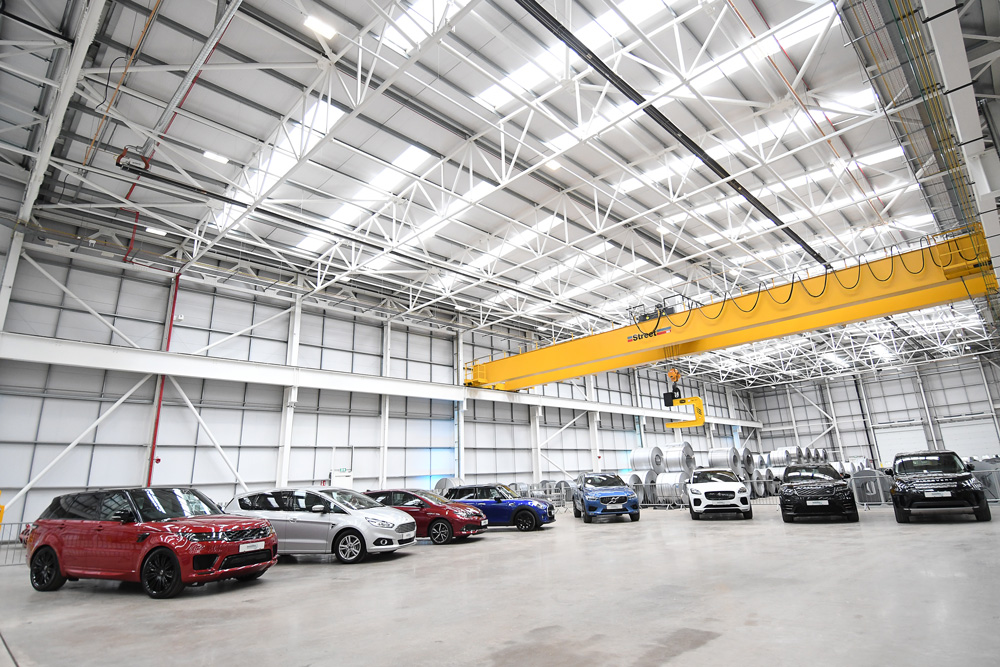
A high capacity steel warehouse for multi-modal transport and logistics contractor, A V Dawson, has installed four overhead cranes, each of 30 tonnes capacity, from Street Crane Company. The cranes will play a crucial role in receiving and despatching steel coils for North East automotive and construction plant manufacturers and are expected to handle up to 290,000 tonnes of steel a year.
The four cranes are necessary to provide zoned stock management in a 36 metre wide single bay building that is 264 metres long. Each double box-beam girder crane spans an exceptional 35 metres and has a Street custom designed and built heavy duty wire rope VX hoist. Approach alarms, flashing beacons and an anti-collision system that will maintain a one bay separation distance between the cranes, all promote greater safety. Full length platforms on each crane ensure safe access for servicing.
Managing director, Gary Dawson, noted, “We opted for Street equipment because of good performance from their cranes and hoists elsewhere in the business. We were reassured in this view by the fact that many of our suppliers and customers, notably TATA, also use Street and it is also good to deal with a family owned British company.”
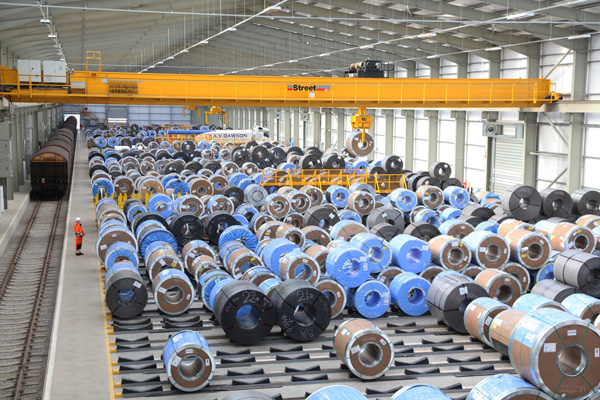
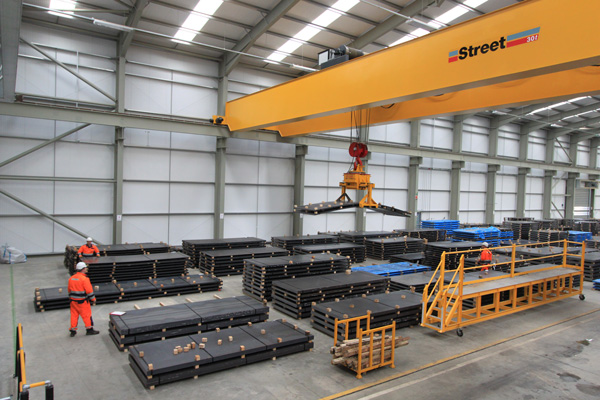
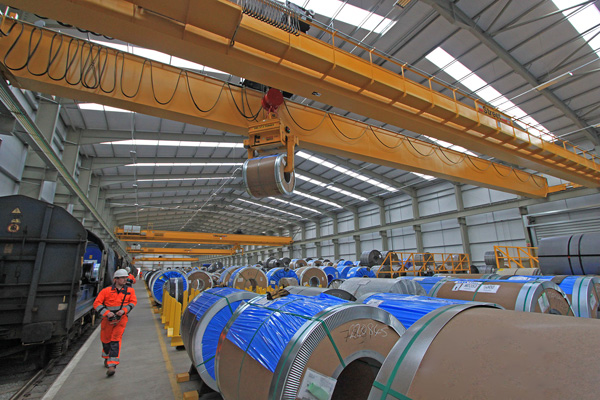
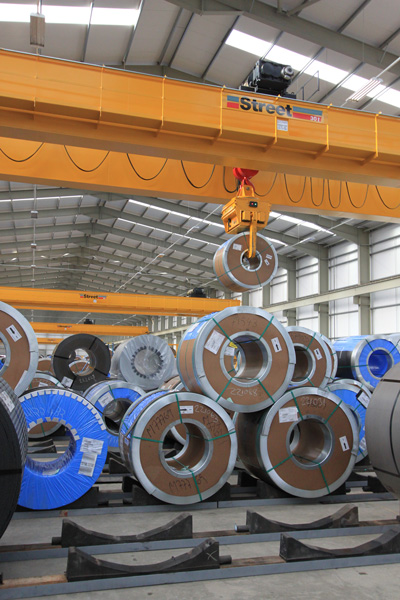
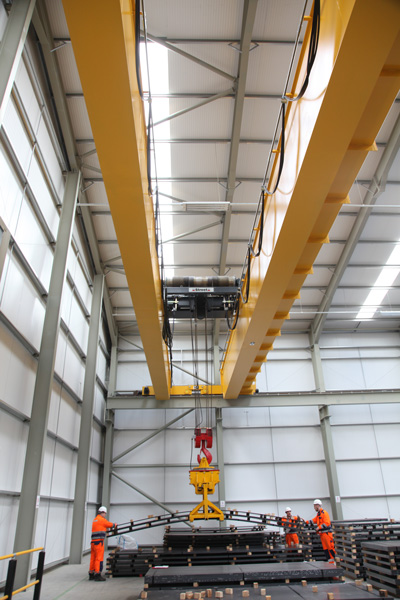
Steel coil will be offloaded into storage from train trucks that can drive right through the building. Coils will be stored in designated areas and transferred from store to road vehicles as local manufacturers call off stock to meet their production needs. Street VX hoists were required because of this high frequency of product movements.
VX hoists are engineered to meet specific handling requirements. This is a robust heavy duty hoist design and in this application, mechanical components are rated M8, to take account of high intensity workload. A particular characteristic of the VX is its true vertical lift, so the hook follows a vertical path enabling product to be placed precisely while eliminating any sideways drag. The open frame design of the hoist provides easy access to major components for servicing. An external brake operating on the first gearbox shaft, away from the drive motor, remains cooler in use and is also more easily inspected and serviced.
The facility has sustainability features to reduce long term energy costs, give greater energy security and provide an internal environment that protects the product from condensation. A constant temperature and humidity will be provided in the building with heating from a deep-bore ground source and power from solar arrays on one side of the roof reducing dependence on the grid. Rainwater will be harvested from the roof and fed into the drainage network via a balance pool to meet the sustainable urban drainage (SUDS) requirements.
Watch the video – time lapse of Street cranes stocking the high capacity steel coil warehouse.
New Overhead Cranes for Streamlined Steel Processing and Despatch at Tata Steel
March 25, 2015
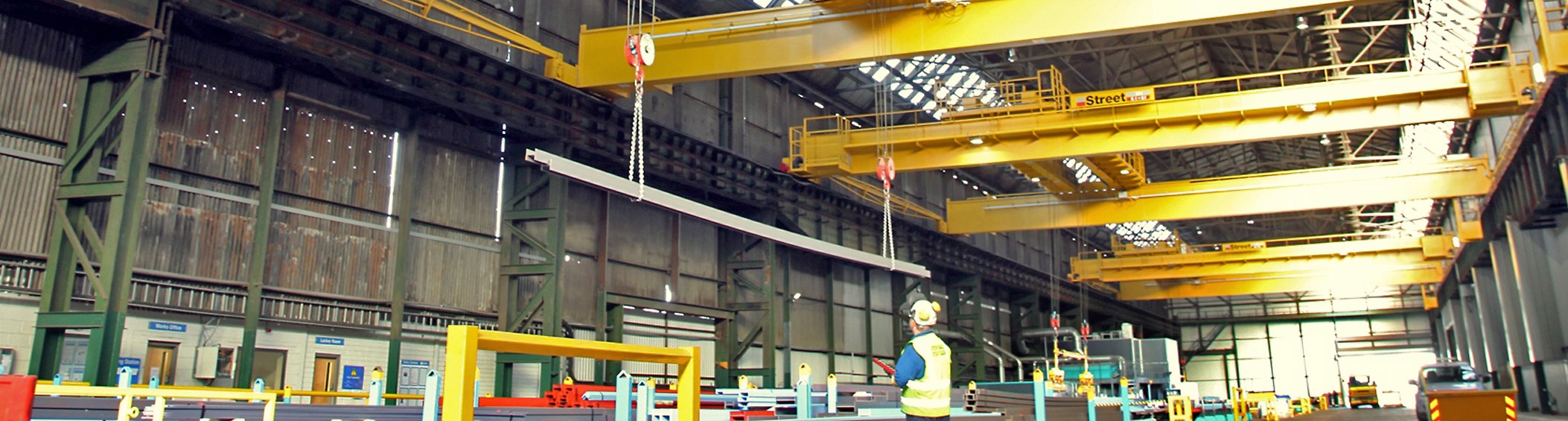
Tata’s steel distribution centre at Redcar has invested in special cranes from Street Crane Company to improve order turnaround.
The Teeside depot refit includes the installation of four 12 tonne SWL overhead travelling cranes of a radically different design that will significantly improve material processing and speed of delivery to customers. Redcar is one of 49 Tata Steel Service Centres nationwide that provide locally accessible steel stock with added value processing to client requirements. Plate and sections for use in engineering and marine fabrications or structural steelwork can be cut, shot blasted and painted prior to delivery to customers ready for the next stage of manufacture. Street Crane’s sales director, explained,
“The high rates of material flow and particular processing needs demanded a more innovative crane configuration. Four cranes have been provided of double bridge design, where two linked beams span the 20 metre bays and on these is fitted a 27 metre crane bridge, bearing twin six tonne hoists. This permits zoned north/south and east/west material flow allowing steel to be brought into the processing bay, with transfer through the shot blast and painting processes before the finished steel is shipped out to customers.”
The twin six tonne hoists on each crane can be operated singly or in tandem for heavier or awkwardly shaped loads giving additional stability. All hoists have magnet lifting from Walker Magnetics. Anti-collision systems permit safe crane movement on a common gantry with audible alarms and amber flashing lights to warn of the other crane approach. Twin floodlights on each crane are operated from the remote controller. Minimising maintenance downtime is vital for maximum productivity. Hours of service metering on all crane motions will assist in planning proactive maintenance to sustain the plants uptime and efficiency. Crane control will be by push button infra-red link to comply with Tata requirements. Other key safety features include taut-wire safety lines to crane bridge platforms and ten safety harness anchor points at key locations such as panels, crabs and end carriages.
Celebration as Street Crane Opens New £3 Million Hoist Factory
February 25, 2015
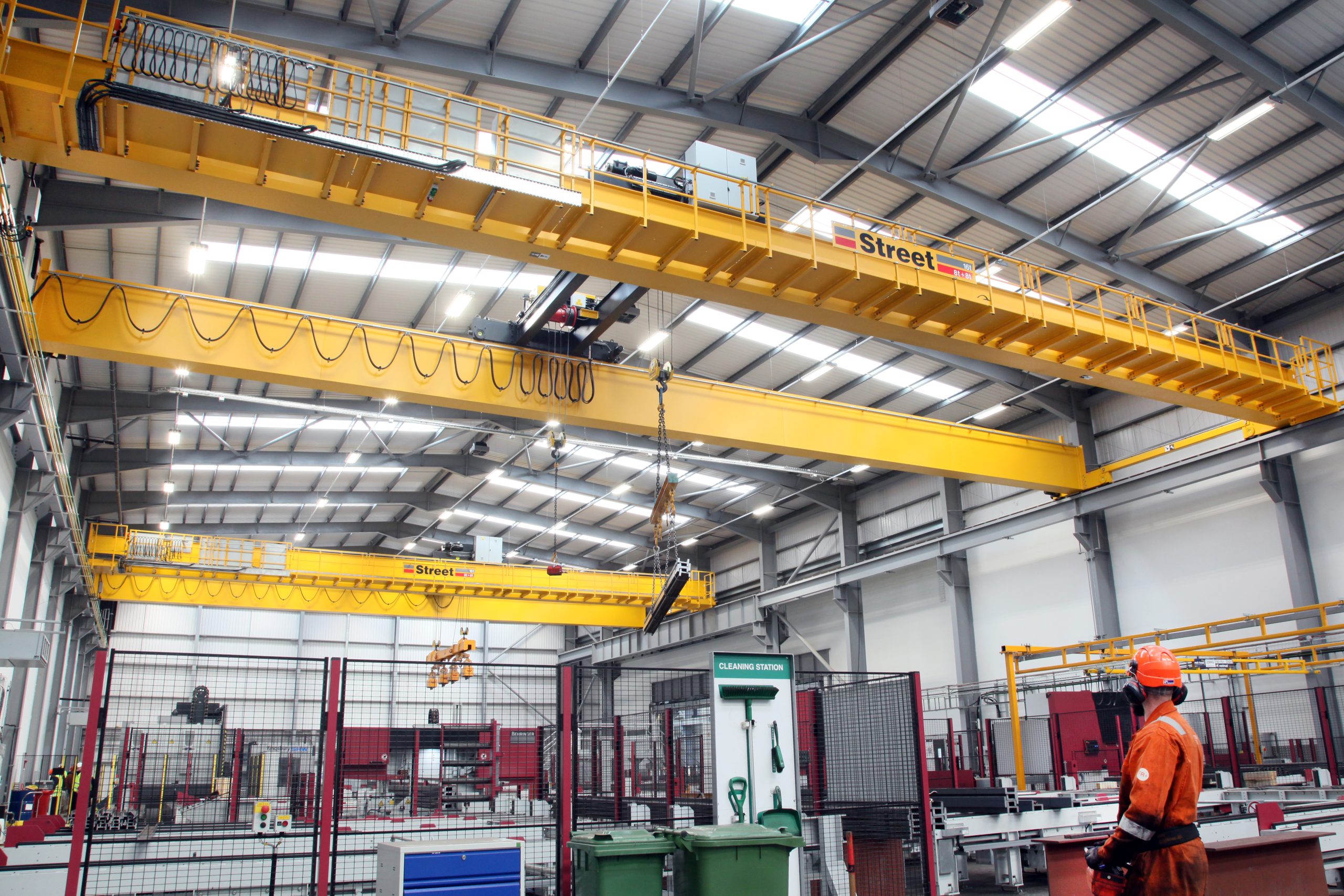
Visitors from around the world joined Street Crane Company to celebrate the opening of their new £3 million hoist factory on Thursday September 11. Street is the UK’s largest crane and hoist manufacturer and around 70 per cent of their £35 million turnover is derived from the sale of hoists and crane kits to overseas manufacturers. “We currently have the strongest order book in our history,” explained managing director, Andrew Pimblett. “We have worked hard to build an international network of nearly 90 overseas distributors in 48 countries. To support our global network we have continually invested in the business, creating products such as our ZX hoist range to meet mainstream lifting needs up to 80 tonnes. This is a product specifically developed for world markets and is designed to conform to multiple international standards and be adaptable to demanding end user requirements.” Though Street Crane operates in a world market dominated by major international competitors, the company’s policy of not building cranes overseas but supplying high technology hoists and electro-mechanical components to other independent crane makers, has really paid off. “This trade is mutually beneficial, because our overseas partners are no longer reliant on the same major multinationals for hoists and components who are also their competitors. In addition they can offer their customers a more unique crane. Increases in hoist production volume that we achieve by exporting gives us scale economies in our home market and supports the research and development that is so essential to stay ahead,” Andrew noted. The new hoist factory will give the company capacity to increase wire rope hoist production from a current level of 2500 hoists to 3200 hoists per year. The company anticipates that, based on current growth, a second shift will be needed by 2016 to double production – bringing further jobs. Over ten per cent of Street Crane’s 200 strong staff work in research and development. This involves the development and refinement of cranes and hoists and also bespoke software for crane design and costing which Street supply to their overseas partners as part of their support package.
Visitors from around the world joined Street Crane Company to celebrate the opening of their new £3 million hoist factory on Thursday September 11. Street is the UK’s largest crane and hoist manufacturer and around 70 per cent of their £35 million turnover is derived from the sale of hoists and crane kits to overseas manufacturers.
“We currently have the strongest order book in our history,” explained managing director, Andrew Pimblett. “We have worked hard to build an international network of nearly 90 overseas distributors in 48 countries. To support our global network we have continually invested in the business, creating products such as our ZX hoist range to meet mainstream lifting needs up to 80 tonnes. This is a product specifically developed for world markets and is designed to conform to multiple international standards and be adaptable to demanding end user requirements.”
Though Street Crane operates in a world market dominated by major international competitors, the company’s policy of not building cranes overseas but supplying high technology hoists and electro-mechanical components to other independent crane makers, has really paid off. “This trade is mutually beneficial, because our overseas partners are no longer reliant on the same major multinationals for hoists and components who are also their competitors. In addition they can offer their customers a more unique crane. Increases in hoist production volume that we achieve by exporting gives us scale economies in our home market and supports the research and development that is so essential to stay ahead,” Andrew noted.
The new hoist factory will give the company capacity to increase wire rope hoist production from a current level of 2500 hoists to 3200 hoists per year. The company anticipates that, based on current growth, a second shift will be needed by 2016 to double production – bringing further jobs.
Over ten per cent of Street Crane’s 200 strong staff work in research and development. This involves the development and refinement of cranes and hoists and also bespoke software for crane design and costing which Street supply to their overseas partners as part of their support package.
Illovo Sugar Warehouse Cranes are Sweet Success for Street Crane and South African Partner, GM Technical Services
November 25, 2014
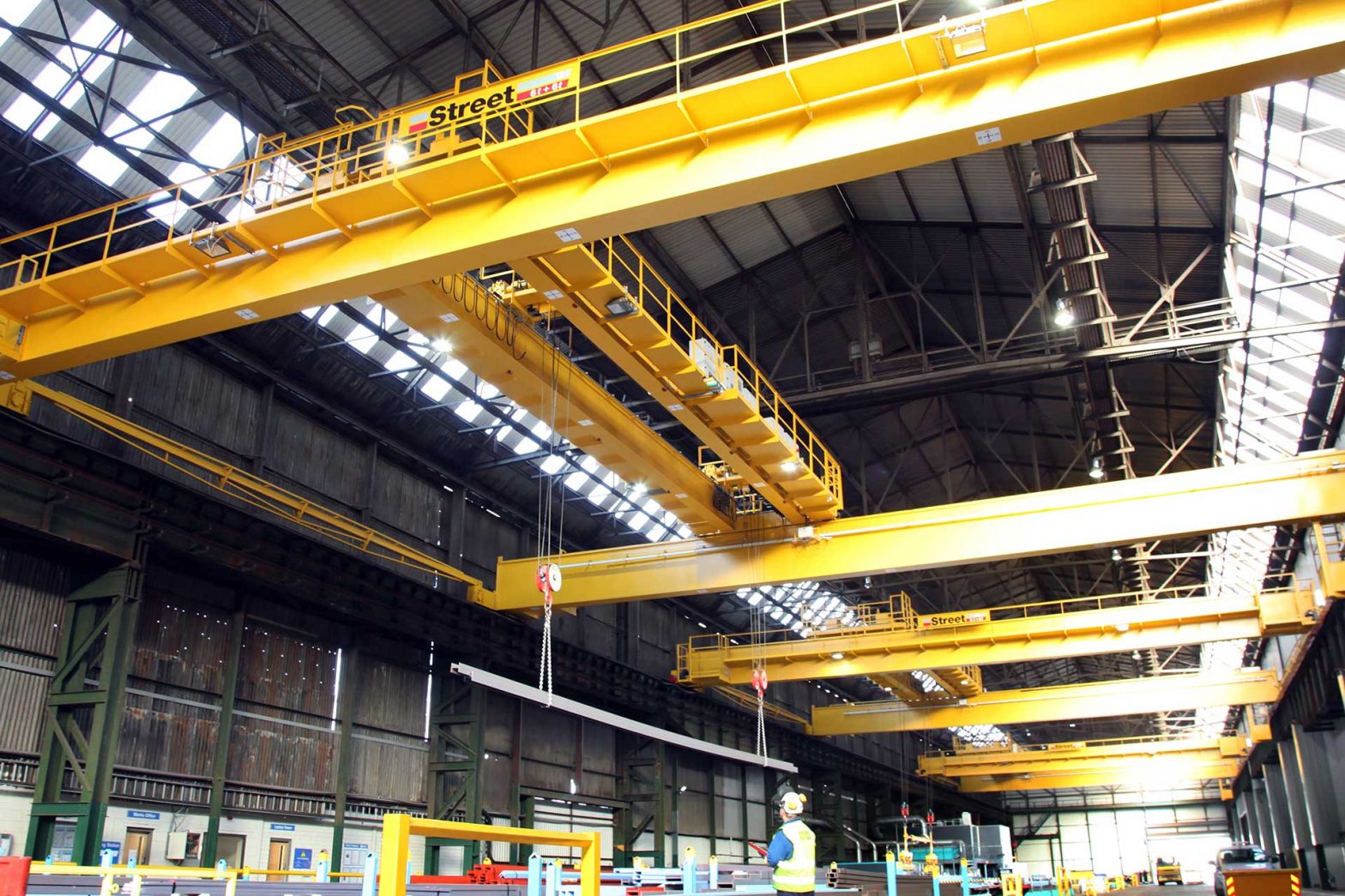
Efficient lifting and handling is assured at Illovo Sugar’s new 51,000 square metre warehouse thanks to six cranes featuring advanced hoists from Street Crane Company in the UK. The cranes were installed by Street’s South African partner, GM Technical Services (GMTS), for the major sugar supplier which supplies numerous southern states of the continent and international markets. With a 170,000 tonne capacity, the warehouse provides storage between Illovo’s primary manufacturing plants and retail, wholesale and industrial customers. Each of the six bays, within zones one and three of the warehouse, incorporates a crane of 16 tonnes safe working load. The 30.72 metre span double girder cranes, including control cabins, link beams, lifting beams, access walkways and bogies were fabricated by GMTS in South Africa with structural drawings supplied by Street Crane. Street supplied from the UK, 12 eight tonne (4+4 tonnes) VX hoists. Each of the custom built twin hoists was reeved on a single hoist drum to ensure synchronised hook movement. GMTS then synchronised the twin hoists on each crane using encoder feedback and inverter drives. Each crane will corner-lift a lifting beam capable of handling ten one-tonne international bulk containers (IBC’s) of sugar per movement. The Street VX is a bespoke designed, open winch format, hoist featuring a dual scrolled barrel to ensure that there is no lateral movement of the load during hoisting and lowering. In this instance all hoist mechanisms are M8, heavy duty rating, reflecting the high frequency of crane use for product movements. For strong performance the cranes are specified with long travel speeds of 60 metres per minute, cross travel of 20m/m and hoist speeds of 7.8 m/m. Smooth and stable load control is guaranteed with the use of variable drive technology on all crane motions. Automated safety incorporated by GMTS include systems to recognise identification tags on personnel and fork lift trucks to stop the crane and avoid collision with the lifting beam. Radio control from the cabins was also supplied by GMTS together with electrical power distribution via an insulated conductor system supplying power to the master hoist panel. Speaking for GMTS, Hannes Steenberg explained, “We won this order because of our ability to meet the demanding technical specification. The M8 mechanisms on the cranes are required because of the intensity of operations and there are few companies in South Africa with the experience and capability to offer such sophisticated equipment. In addition to supply, we have also undertaken to maintain this equipment for five years. Despite the complexity and exacting schedule I am happy to report that we met all deadlines throughout the project.” The new facility is an initiative between Illovo and developer Collins Property Group with operations outsourced to Barloworld Logistics, Illovo’s logistics partner. In addition to the cranes in zones one and three, racked storage for palletised product is employed in zone two with access by fork lift. “The project will produce substantial efficiency gains in the sugar supply chain,” explained Dave Howells, managing director of Illovo Sugar South Africa.
Efficient lifting and handling is assured at Illovo Sugar’s new 51,000 square metre warehouse thanks to six cranes featuring advanced hoists from Street Crane Company in the UK. The cranes were installed by Street’s South African partner, GM Technical Services (GMTS), for the major sugar supplier which supplies numerous southern states of the continent and international markets.
With a 170,000 tonne capacity, the warehouse provides storage between Illovo’s primary manufacturing plants and retail, wholesale and industrial customers. Each of the six bays, within zones one and three of the warehouse, incorporates a crane of 16 tonnes safe working load. The 30.72 metre span double girder cranes, including control cabins, link beams, lifting beams, access walkways and bogies were fabricated by GMTS in South Africa with structural drawings supplied by Street Crane.
Street supplied from the UK, 12 eight tonne (4+4 tonnes) VX hoists. Each of the custom built twin hoists was reeved on a single hoist drum to ensure synchronised hook movement. GMTS then synchronised the twin hoists on each crane using encoder feedback and inverter drives. Each crane will corner-lift a lifting beam capable of handling ten one-tonne international bulk containers (IBC’s) of sugar per movement.
The Street VX is a bespoke designed, open winch format, hoist featuring a dual scrolled barrel to ensure that there is no lateral movement of the load during hoisting and lowering. In this instance all hoist mechanisms are M8, heavy duty rating, reflecting the high frequency of crane use for product movements. For strong performance the cranes are specified with long travel speeds of 60 metres per minute, cross travel of 20m/m and hoist speeds of 7.8 m/m. Smooth and stable load control is guaranteed with the use of variable drive technology on all crane motions.
Automated safety incorporated by GMTS include systems to recognise identification tags on personnel and fork lift trucks to stop the crane and avoid collision with the lifting beam. Radio control from the cabins was also supplied by GMTS together with electrical power distribution via an insulated conductor system supplying power to the master hoist panel.
Speaking for GMTS, Hannes Steenberg explained, “We won this order because of our ability to meet the demanding technical specification. The M8 mechanisms on the cranes are required because of the intensity of operations and there are few companies in South Africa with the experience and capability to offer such sophisticated equipment. In addition to supply, we have also undertaken to maintain this equipment for five years. Despite the complexity and exacting schedule I am happy to report that we met all deadlines throughout the project.”
The new facility is an initiative between Illovo and developer Collins Property Group with operations outsourced to Barloworld Logistics, Illovo’s logistics partner. In addition to the cranes in zones one and three, racked storage for palletised product is employed in zone two with access by fork lift. “The project will produce substantial efficiency gains in the sugar supply chain,” explained Dave Howells, managing director of Illovo Sugar South Africa.
New Cranes for Babcock’s Rosyth Dockyard to Play Key Role in Regeneration
September 25, 2014
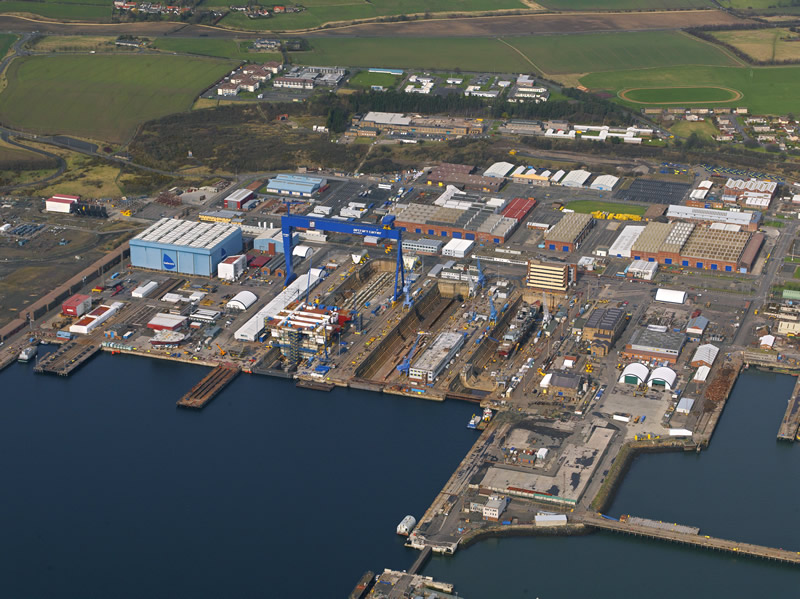
As part of a major upgrade by Babcock to the Rosyth Dockyard, new overhead travelling cranes (OTC’s) have been built and installed by Street Crane Company. Within the package, eight old overhead cranes have been removed and replaced by 19 high specification cranes. The new equipment ensures more efficient and flexible mechanical handling and lifting, with modern standards of safety and performance.
Rosyth is upgrading its facilities to support on-going commercial, marine and offshore projects. To achieve greater flexibility and productivity, the assembly and fabrication bays have been fitted with multiple heavy lift cranes ranging in capacity from ten to 35 tonnes safe working load. All cranes are of double girder construction and benefit from a combination of Street’s advanced ZX hoists and VX custom-built hoists.
Crane efficiency and high levels of availability are assured with heavy usage duty ratings specified on cranes intended for intensive use allied with operational speeds designed to give efficient load movement. For optimum stability all crane motions are controlled by variable frequency inverter control which offers smooth step-free drive acceleration and deceleration characteristics. Digital load displays and mandatory overload protection keeps lifting within prescribed safe limits. Other safety equipment installed includes anti-collision systems, floodlights, flashing approach lights and audible alarms. Control by radio remote allows operators to seek a position that gives greatest safety and visibility. Pendant control provides a failsafe back-up.
Sales director Chris Lindley-Smith commented, “This is a major facilities upgrade programme and we are delighted that our overhead travelling cranes were selected to meet the critical demands of this significant project.” Street Crane completed the installation in September with testing and commissioning through October.
Overhead Cranes Play Crucial Role in Building London Overground Trains
July 25, 2014
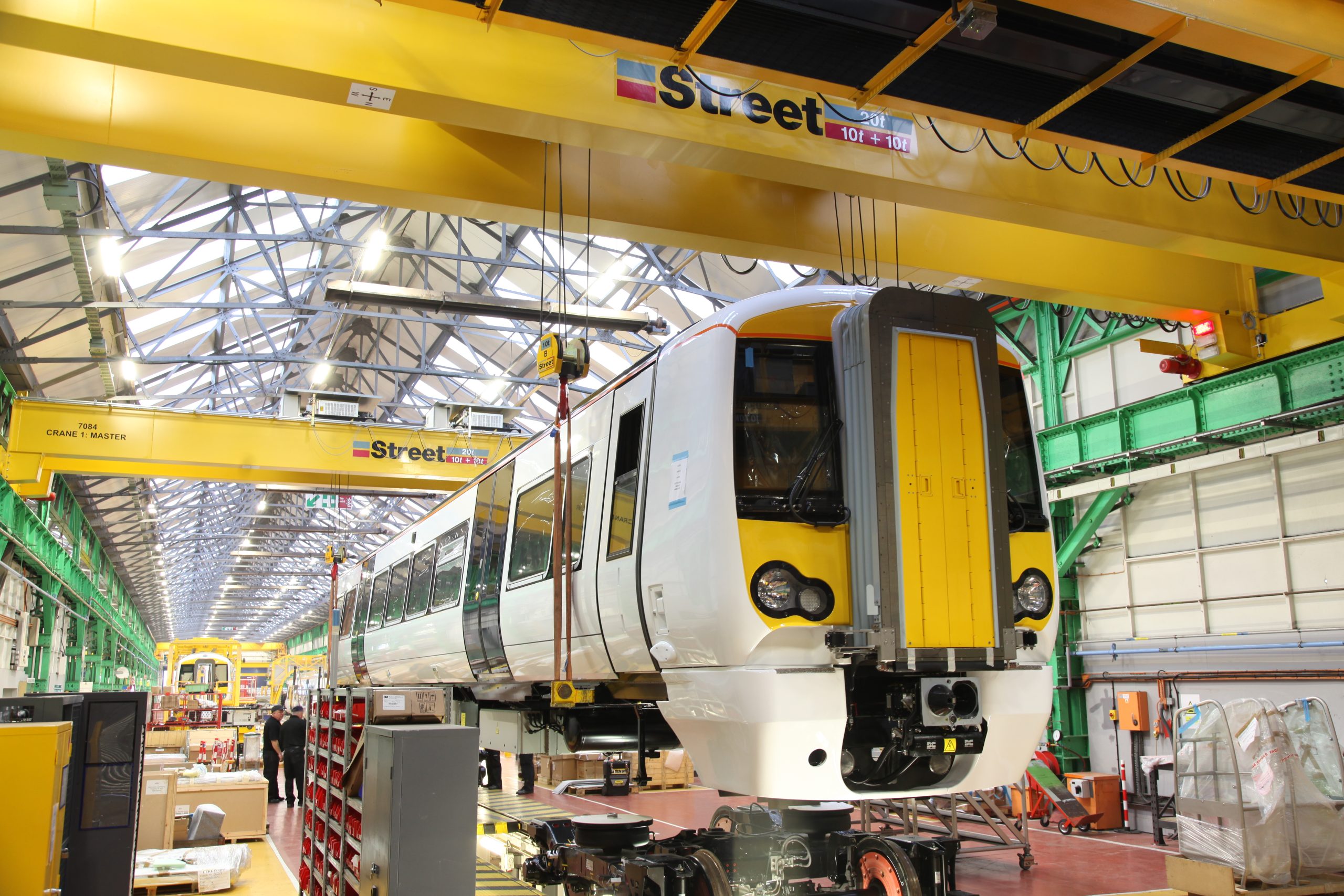
Two overhead cranes from Street Crane Company are playing a vital role at Bombardier’s Derby factory in the building of new trains to revitalise the capital’s rail commuter services. The cranes are used in the final assembly of new Electrostar overground trains, contributing to the safety and productivity of the streamlined production operations.
“Bombardier’s technically demanding specification required highly specified factory cranes that ensured safe, continuous and flexible working in an extremely intensive production environment,” explained Street Crane sales director Gus Zona. Two identical 20 tonne safe working load cranes have been installed. Each is fitted with twin ZX series ten-tonne hoists for assured lifting and handling. The cranes will be used independently during the assembly of the trains, but are designed for tandem operation when lifting and moving complete train bodies.
Special on-crane safety equipment includes audible alarms as the cranes move up the workshop. Anti collision devices provide a safeguard when the two cranes are operated and moving independently. For tandem crane lifts and transportation a unified radio-based control system is used. This ensures the complete interlocking of overhead crane operations and total synchronisation of all movements.
To ensure efficient production, the cranes can transport loads at speeds of 40 metres/min in long travel down the 180 metre long workshop. Cross travel speeds of 20 metres per minute can be obtained and hoist speeds of up to four metres/min. All crane travel motions are under inverter control to ensure safe acceleration and deceleration for load stability and to provide precision low speed final placement.
Many of the Bombardier Electrostar trains have already been delivered and will service the London Overground to the north and east of the capital. Bombardier’s Derby factory is working a three shift system to complete the order.
Overhead Crane Used in Helicopter Life Saving Escape Training
November 15, 2013
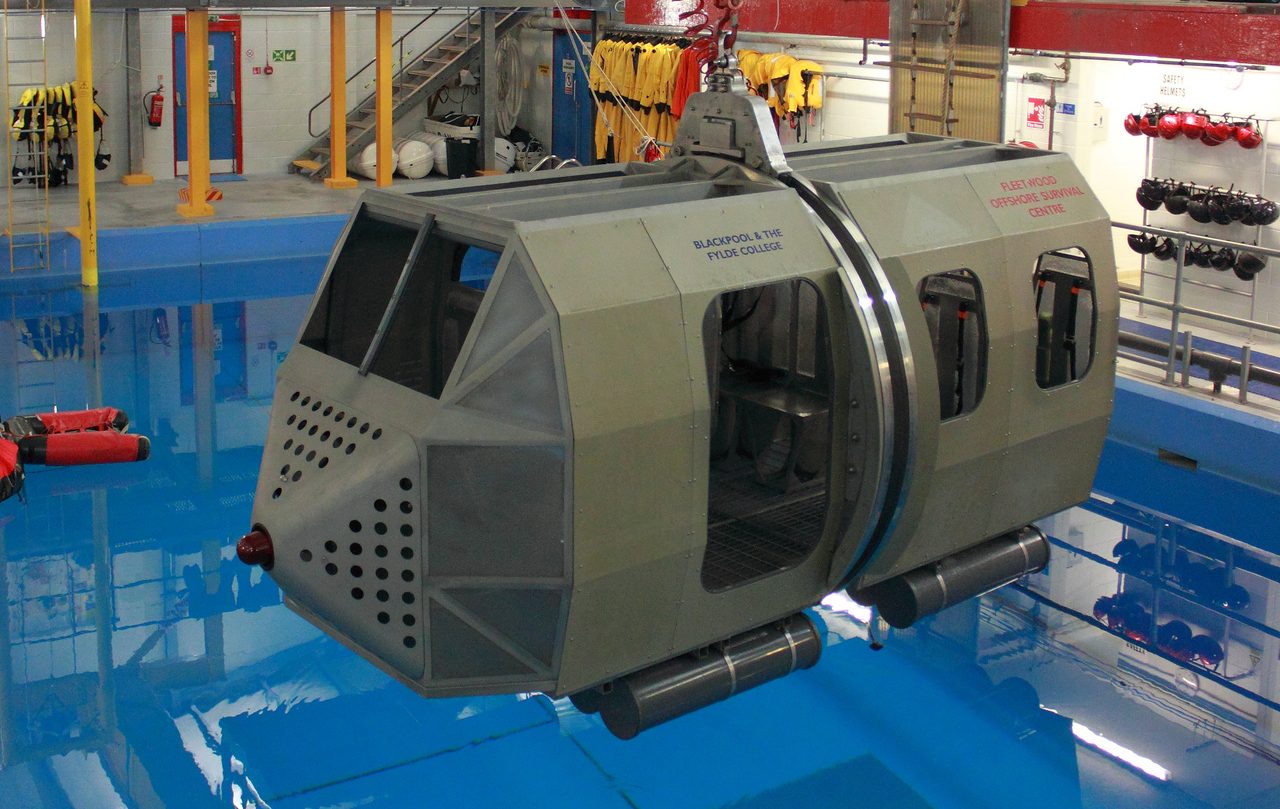
An overhead crane that enables trainees to simulate the stress of a helicopter ditching into the sea is in operation at Blackpool College’s Fleetwood Nautical Campus (FNC). The four tonne safe working load crane was installed by Britain’s largest industrial crane maker, Street Crane Company. The Campus is one of a handful of centres in the UK providing vital marine helicopter escape training for North Sea, military and emergency services personnel.
The safety training systems were designed by EDM, a company specialising in simulators for aviation training. EDM produced the module known as the helicopter under water escape trainer HUET. This replicates the body of a helicopter cab with the same arrangement of seating, seat belts, doors and glazing as a real helicopter. For safety the rear of the module is open for diver access.
FNC is a dedicated facility with a specially constructed pool where one metre waves, darkness and rain can be simulated. The crane spans the pool and side apron. Up to four trainees, with an instructor, strap themselves in before the pod is hoisted and moved out to the centre of the pool. From this position the HUET can be lowered onto the water, immersed in the water or immersed and rolled over. Trainees then have to unstrap themselves, put on respirators and make a safe exit. Besides the instructor in the HUET, divers in the water can intervene via an open end to the simulator and the instructor can also auto release all seat belts from his console if a trainee is at any risk.
“This is one of the most unusual applications that we have had for our cranes,” explained Street Crane managing director Andrew Pimblett. “In engineering terms it is a relatively straightforward fixed position goal post crane with only lateral and horizontal movement. A single beam, supported on A frames, has an underslung hoist to hold the HUET. The unusual item is a dual coil spring that moderates the fall and allows the module to be suspended over the water before release at one metre above the water.”
Technical Expertise Combined to Bring Advanced Factory Cranes to UAE
December 25, 2012
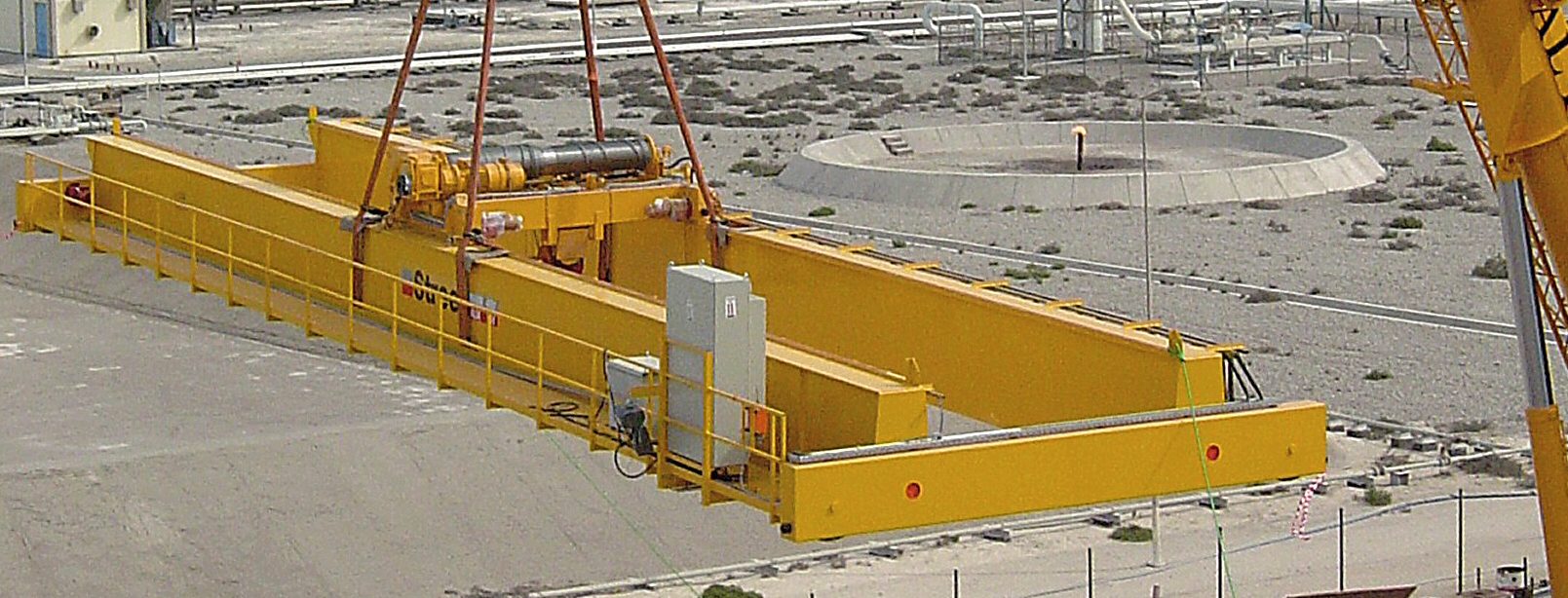
Advanced specification factory cranes will now be available in the UAE following an agreement between Dubai Cranes LLC and Street Crane Company of the UK. Under the agreement Dubai Crane will carry in-depth stock of crane kits from Street Crane, allowing express delivery to local manufacturers and industrial investors in the UAE.
Dubai Crane is a subsidiary of Dubai Investment PJSC a public company with a total asset value of AED 14.745 billion (USD 4 billion) and interests in 47 companies spanning activities such as building, development, glass, technology, plastics, pharmaceuticals and food. Street Crane is the UK’s largest factory crane manufacturer and operates globally via a network of over 60 high quality local trading partners.
Under the agreement Street Crane will share technical expertise with Dubai Crane so that major crane structures such as gantries and crane beams can be fabricated in Dubai. These structures will then be mated to electro-mechanical systems such as end carriages, carriages, hoists, controls and electrical gear supplied by Street Crane to create advanced world-class cranes.
Stock holding by Dubai Crane will mean prompt delivery for single or double girder cranes of up to 25 tonnes safe working load and up to 30 metres span. In addition, technical collaboration allows the companies to undertake major complex infrastructure projects. One such project is the recently completed Emirates Aluminium plant, a multi million US dollar investment, with 15 overhead cranes installed with capacities from three to 50 tonnes. Some cranes on site have auxiliary hoists to assist in the tipping of ladles and all the cranes were designed and engineered for intensive use in a harsh environment.
Speaking for Dubai Crane, general manager Andy Kay explained, “Industrial development in the UAE is such that there will be huge demand for high specification industrial cranes for the foreseeable future. This is especially true of the mid and downstream cluster businesses capitalising on developments at Kalifa Port and the aluminium industry. We are able to meet demands for cranes of up to 300 tonnes safe working load. We will provide whole-life support from the initial evaluation of handling requirements, through the design and installation of the crane, to the support and service of the equipment to ensure a long and efficient operational life.”
Speaking for Street Crane, managing director Andrew Pimblett commented, “We are delighted to conclude an agreement with such a high profile and well resourced local partner. Local fabrication of major crane elements provides a better service for customers and creates value in the local economy, creating a win-win for all the project partners.”