Understanding Crane Duty Ratings: From M3 to M8
July 29, 2026
Specifying an overhead crane based solely on Safe Working Load (SWL) is one of the most expensive errors an engineering team can make.
While SWL dictates what a crane can lift in a single operation, its duty rating determines whether it can survive your production schedule. A crane that can lift the load is not always the crane that can live with the workload.
Duty rating connects the initial mechanical specification directly to the real operational environment: how frequently the crane operates, how close each lift is to maximum capacity, how long mechanisms remain in motion, and the cumulative structural strain the equipment must absorb across its operational life.
A 10 tonne crane used occasionally for facility maintenance demands a fundamentally different mechanical design from a 10 tonne crane supporting production across multiple daily shifts. The rated capacity remains identical: the operational duty requirement does not.
At Street Crane, we evaluate both dimensions. Backed by nearly 80 years of UK manufacturing and lifting expertise, our consultative role is to assist project teams in specifying lifting systems precisely matched to the workload, the supporting facility, the process integration, and the required long-term operational performance.
What is a crane duty rating?
A crane duty rating classifies the intended operating intensity of a lifting system. It dictates the structural and thermal limits of critical drive mechanisms, including the hoist unit, trolley, crab, and end carriages.
In simple terms, higher duty ratings reflect more demanding industrial applications. Equipment designed for elevated duty cycles incorporates heavily engineered components, including larger motor frames, higher-rated gearboxes, and reinforced mechanical assemblies. These prevent drive units from labouring, overheating, or suffering premature fatigue under continuous operation.
This distinction is critical to facility uptime. A crane may safely execute a maximum-capacity lift, but if forced to handle heavy loads too frequently, for extended durations, or near its upper threshold, an under-rated classification will compromise system reliability, inflate maintenance costs, and shorten service life.
Selecting the correct rating protects more than the crane itself. It safeguards production output, operational safety, maintenance budgets, and total lifetime asset value.
M3 to M8 crane duty ratings explained
Primary crane duty ratings range from M3 through to M8 under standard classification frameworks. Each step represents a step-change in mechanical fatigue resistance and daily operating endurance.
The approved Street Cranexpress guidance outlines these ratings using a practical benchmark: lifting approximately 63% of the crane’s safe working load during active operation.
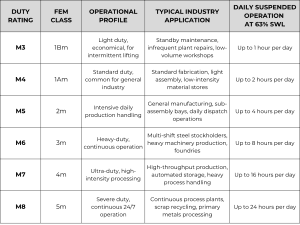
Specifying equipment is not a matter of selecting the highest rating available. Over-specifying introduces unnecessary capital expenditure without operational gain. Correct specification means accurately aligning the mechanical design with the true operational rhythm of the plant.
Capacity and duty are distinct specifications
One of the most frequent procurement mistakes is assessing crane requirements through safe working load alone.
- Safe working load answers the structural question: what can the crane lift?
- Duty rating answers the operational question: how hard can the crane work, and for how long, without premature component fatigue?
A crane lifting near maximum capacity once per week exerts a vastly different fatigue profile from a crane moving moderate loads hundreds of times per shift. While both may require identical SWL ratings on paper, their duty requirements are entirely distinct.
The load spectrum is equally critical. A system handling light items with occasional maximum lifts operates under a far lighter stress regime than a crane moving heavy loads continuously. Frequent heavy cycles place severe thermal and mechanical stress on motors, electro-mechanical brakes, gearboxes, wire ropes, wheels, and end carriages.
Correct duty specification ensures the lifting system operates strictly within its engineered envelope, protecting both mechanical integrity and long-term operating margins.
Operational and financial risks of under-specification
An under-rated crane rarely fails during initial commissioning. It fails under the sustained pressure of daily production.
The equipment may lift its rated load, pass statutory inspections, and operate satisfactorily upon installation. Problems manifest later, once exposed to the true operational cycle of the facility.
The Commercial Impact of Under-Specified Duty
- Unplanned Production Line Stoppages: Drive motor overheating or brake failure on an under-rated crane brings connected processes to a complete standstill.
- Inflated Operational Expenditure: Accelerated wear on gearboxes, ropes, and wheel bearings turns a lower initial capital cost into excessive maintenance spend within 18 to 24 months.
- Premature Capital Replacement: Mechanical assemblies operating past their design fatigue limits experience drastically shortened service lives, requiring early capital reinvestment.
High-duty applications and engineered solutions
Higher duty ratings are essential where lifting infrastructure is central to plant output, operates across multiple shifts, or forms an integrated component of a continuous process.
This is where M6, M7, and M8 classifications become vital.
Street Crane’s VX double girder cranes are engineered specifically for demanding industrial environments, supporting duty ratings up to M8 / CMAA Class F. Featuring open-winch hoists, true vertical lifting paths, gearboxes with integrated safety brakes, and accessible layouts for streamlined maintenance, the VX range delivers sustained performance under extreme duty cycles.
For specialised operational demands, custom lifting machinery can be engineered around exact process criteria, incorporating extreme ambient temperature ratings, dust protection, or automated control integration.
Integrating duty ratings into facility design
Duty rating directly impacts the overall engineering specification. It determines drive selection, gearbox sizing, motor cooling, control architecture, and structural design.
Crucially, duty ratings also dictate wider civil and structural engineering requirements for the host facility.
Why Duty Rating Belongs in the Early Design Phase
Selecting a higher duty classification increases dynamic wheel loads, alters structural load paths, and influences runway beam sizing. Early coordination between crane engineers, structural consultants, and project architects ensures building steelwork and civil foundations are designed efficiently, preventing expensive structural retrofits prior to installation.
To support precise movement and reduce mechanical shock across high-duty cycles, advanced control systems such as Variable Frequency Drives (VFDs) are routinely integrated. Smooth acceleration and controlled deceleration protect both the mechanical drives and the building infrastructure from shock loading.
Technical criteria for duty specification
Determining the precise duty rating requires a clear assessment of operational parameters. Prior to finalising a specification, project teams should evaluate:
- Capacity Profile: What is the maximum safe working load, and what is the typical daily operational load?
- Cycle Frequency: How many lifts or movements are executed per hour, per shift, and per day?
- Operating Hours: Will the equipment support single-shift, multi-shift, or continuous 24/7 production?
- Process Criticality: What is the financial cost per hour if the lifting system becomes unavailable?
- Environmental Factors: Are there elevated ambient temperatures, airborne particulates, or outdoor exposures?
- Future Demands: Is production volume expected to scale up over the asset’s operating lifespan?
Evaluating these factors transforms duty rating from a theoretical classification into an exact engineering decision, ensuring capital is deployed efficiently without exposing the facility to operational risk.
Consultative engineering for long-term reliability
At Street Crane, we evaluate equipment performance across its entire operational lifespan. A lifting system must be engineered for how it will be operated, maintained, and relied upon over decades of service.
Achieving this requires looking beyond static load capacity to analyse duty cycles, structural dynamics, control requirements, and service access.
As an independent British manufacturer, we partner with project teams, plant managers, and consulting engineers to provide authoritative technical guidance, ensuring every lifting system delivers safe, reliable, and cost-effective performance.
Optimise Your Crane Specification Before Tender
Unsure if your proposed crane specification matches your actual operational duty cycle?
Contact our senior engineering team to conduct a comprehensive duty cycle audit of your lifting requirements prior to finalising project specifications.
Telephone: +44 (0)1298 812456
Email: website@streetcrane.co.uk